When It Helps, When It Fails, and How to Use It Without Wasting Your Time
Cardio has been sold as the holy grail of weight loss for decades. More miles. More sweat. More suffering.
And yet most people who “do cardio” struggle to lose fat long-term or keep it off.
That’s not because cardio is useless. It’s because it’s misunderstood, overused, and badly programmed.
Let’s talk honestly about what cardio actually does, where it helps, where it fails, and how to pair it with strength training to lose fat without wrecking your body.
What Cardio Is Actually Good At
Cardio does a few things very well:
Improves heart and lung capacity
Increases work capacity
Burns calories during the session
Helps manage stress for some people
Those are real benefits. The problem is what cardio doesn’t do.
Where Cardio Fails for Fat Loss
1. Cardio Alone Is a Terrible Fat-Loss Strategy
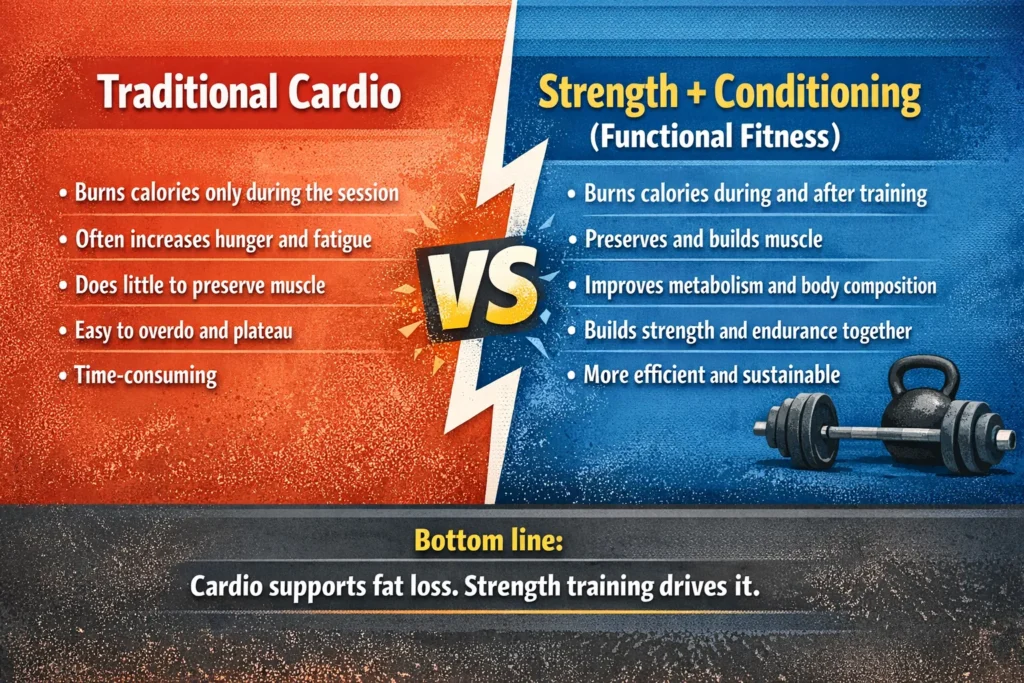
Long, steady cardio burns calories while you’re doing it, but it does very little to:
Preserve muscle
Increase metabolism long term
Improve strength or body composition
That’s why people can run or bike for months and still look and feel the same.
Calories burned ≠ fat lost.
2. More Cardio Often Leads to Less Progress
Excessive cardio creates problems:
Increased hunger and cravings
Muscle loss if strength work is missing
Chronic fatigue and burnout
Plateaued results
If your solution to stalled progress is “do more cardio,” you’re usually digging the hole deeper.
3. Cardio Becomes a Compensation Tool
Many people use cardio to “undo” poor habits:
Overeating
Inconsistent training
Lack of sleep
That mindset never works long-term. Fat loss comes from systems, not punishment.
What Actually Drives Fat Loss
Fat loss happens when you:
Build or preserve muscle
Train with intensity and intent
Manage recovery and stress
Create sustainable habits
This is where strength training and functional fitness change the game.
Why Strength Training Is Non-Negotiable
Strength training:
Preserves lean muscle
Increases metabolic demand
Improves insulin sensitivity
Shapes your body as fat comes off
Without strength training, weight loss often means losing muscle along with fat. That’s why people end up smaller but softer, tired, and frustrated.
The Right Way to Use Cardio for Fat Loss
Cardio works best when it supports strength training, not replaces it.
1. Use Cardio for Conditioning, Not Punishment
Shorter, intentional sessions beat long slogs.
Examples:
Intervals on a bike or rower
Short running efforts mixed with rest
Circuits that elevate heart rate while moving load
This builds fitness and supports fat loss.
2. Pair Cardio With Strength in the Same Session
This is where functional fitness shines.
You lift. You move. You condition.
The result:
Higher calorie burn overall
Muscle preservation
Better conditioning
Less time wasted
3. Let Kickboxing Do the Heavy Lifting
Kickboxing is cardio, but it doesn’t feel like cardio.
It builds:
Endurance
Coordination
Core strength
Mental engagement
People stick with it because it’s challenging and purposeful, not monotonous.
Consistency beats calorie math every time.
How Often Should You Do Cardio?
For most people:
2 to 4 conditioning sessions per week
Strength training as the foundation
At least one recovery day
More is not better. Better is better.
What About Walking?
Walking is underrated and extremely useful.
It:
Supports recovery
Helps manage stress
Increases daily movement without fatigue
Walking plus structured training is far more effective than endless “hard cardio.”
The Warrior Fitness Approach
At Warrior Fitness, cardio is not the plan. It’s a tool.
We focus on:
Functional strength training
Conditioning that makes sense
Kickboxing for endurance and confidence
Coaching that prevents burnout
You don’t need hours on a treadmill. You need a smarter system.
Bottom Line
Cardio isn’t the enemy. But it’s not the solution by itself.
If fat loss is your goal:
Lift weights
Move with intent
Condition intelligently
Recover properly
That’s how results actually happen.
Want to Train Smarter Instead of Harder?
We offer a free trial class so you can experience:
There’s a timeless mantra that holds true: “Strength is the foundation.” Whether you’re a seasoned gym-goer or just dipping your toes into the world of fitness, you’ve likely come across the term “5×5 strength workout.” This tried-and-true training approach has been hailed as a cornerstone of effective strength building and muscle development. In this comprehensive guide, we’ll delve into the ins and outs of 5×5 strength workouts, shedding light on why you should consider incorporating them into your fitness routine.
Understanding the Basics: What is a 5×5 Strength Workout?
What Does “5×5” Mean?
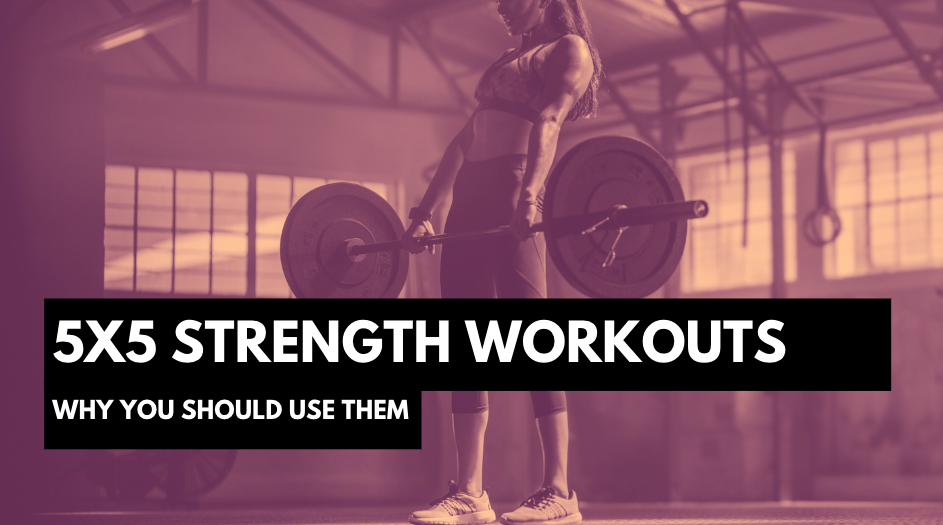
The term “5×5” refers to a specific set and rep scheme commonly used in strength training. It involves performing five sets of five repetitions for a given exercise. This format is renowned for its simplicity and effectiveness, providing a balanced combination of volume and intensity.
Compound Movements Take Center Stage
At the heart of every 5×5 strength workout lie compound movements. These multi-joint exercises engage multiple muscle groups simultaneously, leading to efficient muscle development and functional strength. Squats, deadlifts, bench presses, overhead presses, and rows are quintessential examples of compound movements frequently integrated into 5×5 routines.
The Advantages of 5×5 Strength Workouts
1. Efficient Muscle Development
The 5×5 approach thrives on progressive overload, a fundamental principle for muscle growth. By consistently increasing the weight you lift, you challenge your muscles, prompting them to adapt and grow stronger over time. This results in well-rounded and substantial muscle development.
2. Time-Effective Workouts
Modern life often leaves us juggling numerous responsibilities, making time a precious commodity. 5×5 strength workouts are renowned for their efficiency, enabling you to target major muscle groups and achieve significant results in a concise timeframe.
3. Boosted Functional Strength
Functional strength is the ability of your muscles to perform real-world tasks effectively. Compound movements in 5×5 workouts enhance your functional strength, equipping you to tackle daily activities and athletic pursuits with greater ease and confidence.
4. Enhanced Fat Loss
Muscle is a metabolically active tissue, meaning it burns calories even at rest. Engaging in 5×5 strength training can contribute to an increase in lean muscle mass, elevating your resting metabolic rate and aiding in fat loss endeavors.
5. Mental Resilience
Success in strength training extends beyond the physical realm. As you conquer challenging lifts and progressively achieve your goals, you cultivate mental resilience and a sense of accomplishment that transcends into other areas of your life.
Getting Started with Your 5×5 Strength Journey
1. Consultation and Assessment
Before embarking on any fitness regimen, it’s prudent to consult a qualified fitness professional. They can assess your current fitness level, discuss your goals, and tailor a 5×5 strength workout plan that aligns with your aspirations.
2. Proper Technique is Paramount
Executing exercises with proper form is non-negotiable in strength training. Improper technique not only diminishes results but also increases the risk of injury. Enlist the guidance of a coach or trainer to ensure your movements are precise and safe.
3. Gradual Progression
The 5×5 strength approach thrives on gradual progression. Begin with weights that challenge you without compromising form. Over time, steadily increase the weight you lift, allowing your muscles to adapt progressively.
4. Balanced Nutrition and Recovery
Support your strength-building journey with a balanced and nutrient-rich diet. Adequate protein intake is crucial for muscle repair and growth. Equally important is prioritizing recovery through sufficient sleep and active rest days.
5. Consistency and Patience
Rome wasn’t built in a day, and neither is strength. Consistency is key in any fitness endeavor. Embrace the process, celebrate small victories, and stay patient as you witness the transformative power of 5×5 strength workouts.
Wrap-up
In a fitness landscape brimming with trendy workouts and quick-fix solutions, the enduring effectiveness of 5×5 strength workouts stands as a testament to their efficacy. By incorporating compound movements, promoting muscle growth, and fostering mental resilience, these workouts offer a holistic approach to strength building. As you embark on your journey, remember that the path to strength is a marathon, not a sprint. Embrace the challenge, stay committed, and let the transformative benefits of 5×5 strength training propel you toward your fitness goals.